
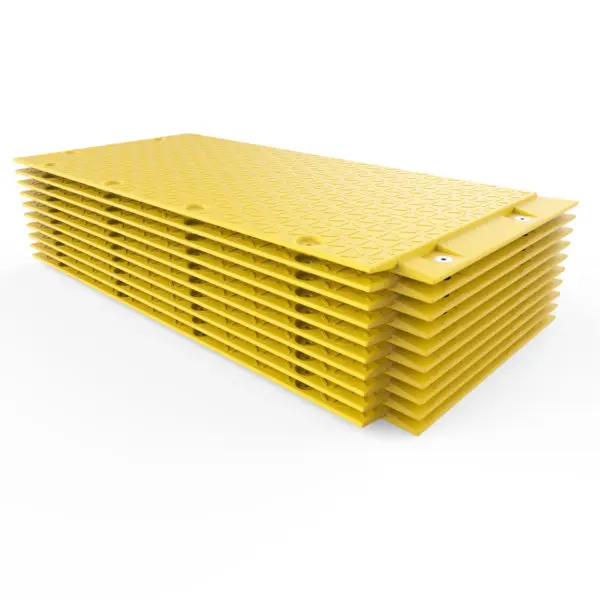
Ground Protection Mats are widely used engineering materials, mainly serving to improve road and site conditions, ensuring the smooth progress of construction and the safety of personnel. The specific uses of Ground Protection Mats are as follows:
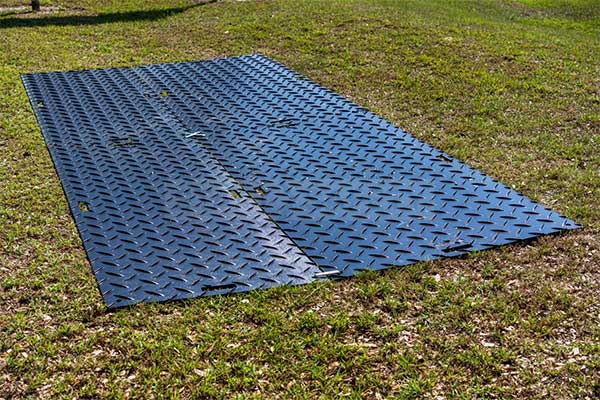
First of all, Ground Protection Mats are generally used in the laying of temporary roads and sites. The Ground Protection Mats are easy-to-install, they can be quickly laid on complex terrains such as deserts, swamps, muddy ground, seashores, and construction sites to serve as temporary road surfaces. This effectively addresses the impacts of poor road conditions and adverse weather, guaranteeing construction progress and safety.
Secondly, Ground Protection Mats find extensive applications in fields like farmland water conservancy, construction engineering, and traffic engineering. They can be utilized in the construction and maintenance of canals, reservoirs, and embankments, providing structural support for construction projects such as cofferdams, foundations, underground parking lots, and simple earthquake-resistant houses. In traffic engineering, Ground Protection Mats can be applied to sub-grade protection, road construction, as well as the construction of port terminals, offering solid support for the building of transportation infrastructure.

In addition, Ground Protection Mats also play a significant role in disaster relief and military emergency situations. In such emergencies like earthquakes, they can be used to quickly build temporary roads or repair roads that have been severely damaged over a wide area, facilitating rescue work. Meanwhile, they can also be employed in disaster relief operations for natural disasters such as flood control, waterlogged drainage, landslide prevention, collapse prevention, debris flow prevention, and sandstorm prevention, ensuring that rescue workers can reach the disaster-stricken areas smoothly.
It is also worth mentioning that Ground Protection Mats possess excellent anti-slip properties. Therefore, they are more suitable for use in places such as roads and ramps during rainy and snowy weather compared to other materials. Moreover, HDPE materials have the characteristics of being recyclable. After used, they can be recycled through proper treatment, they are environmentally, and having a relatively small impact on the environment and conforming to the concept of sustainable development.
To sum up, due to their lightweight, easy installation, anti-slip, and recyclable characteristics, polyethylene paving plates have a wide range of uses in multiple fields. They can not only be used for laying temporary roads and sites but also for the construction of farmland water conservancy, construction engineering, and traffic engineering, as well as in disaster relief and military emergency situations.